The Daily Tale: Collaborative Writing Platform
Background story
In my spare time, I do improv, which is a collaborative art of “yes, and“. I was inspired the classic improv game “One Word Story“, where players in a circle take turns saying exactly one word at a time to build a coherent narrative. So I asked myself, why not turn it into a connecting and shareable experience for anyone who wants to build a story with anyone in the world?
Beside, this is part of my practice in building with AI, and to see if I can make a website all the way from design to finally deploy it.
What it does
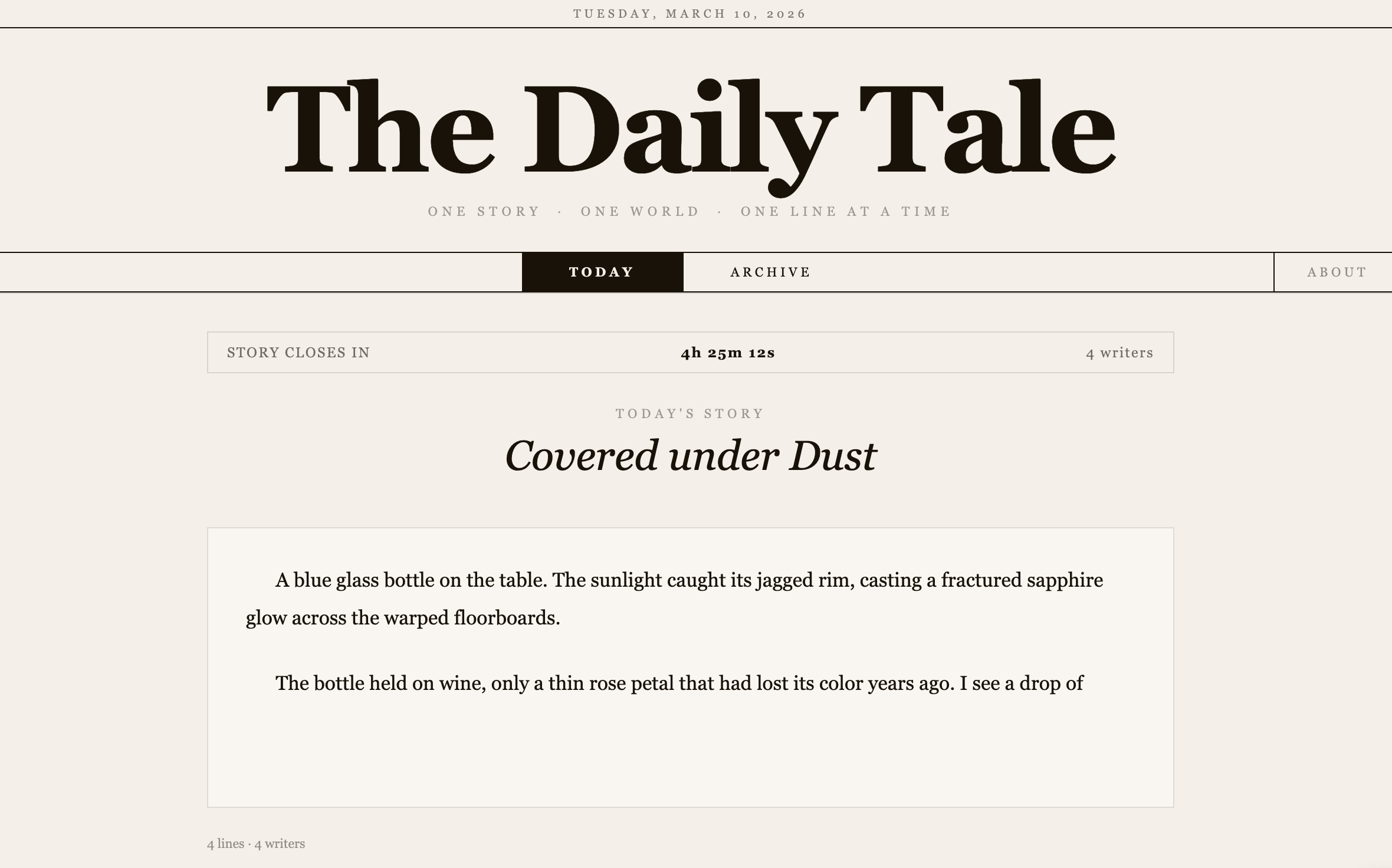
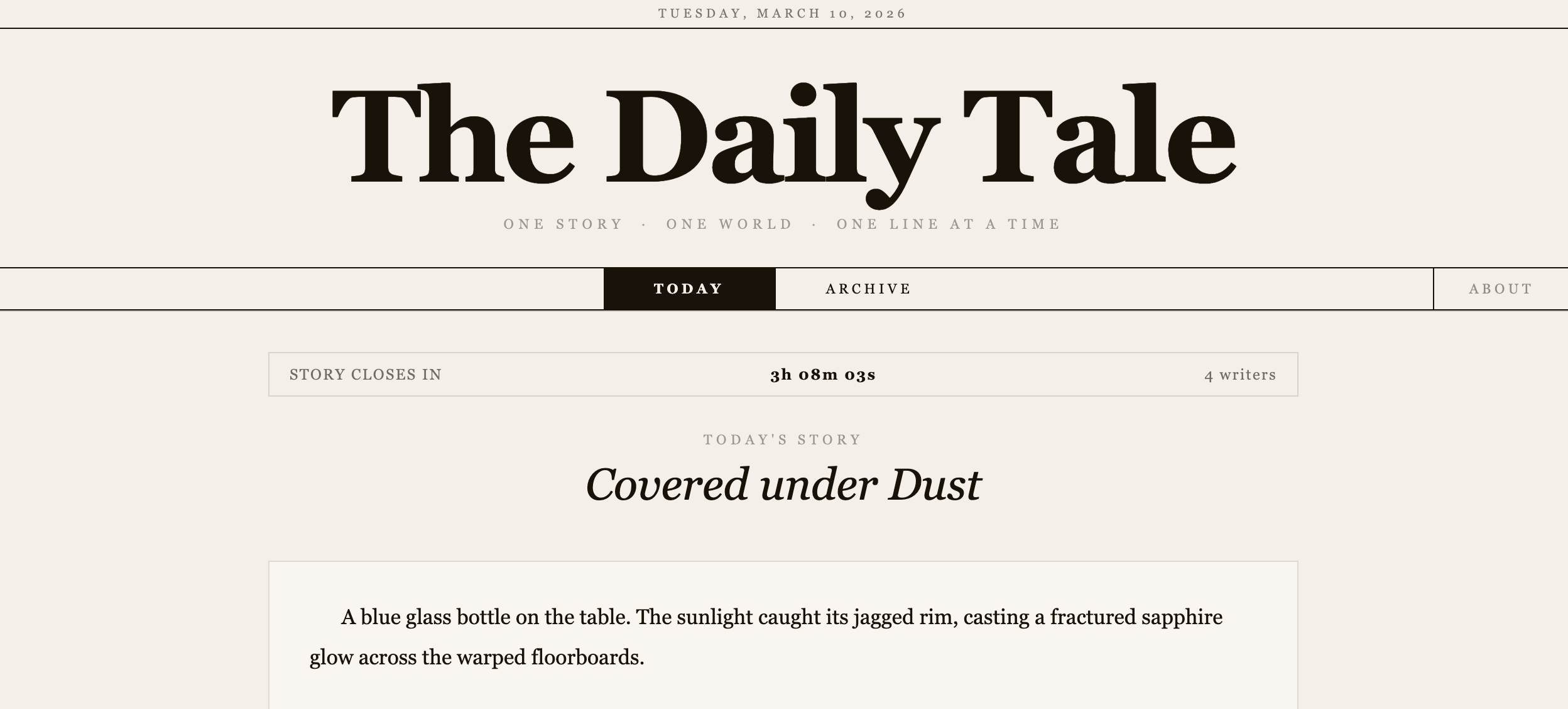
An open platform that everyone can add to a story a day together
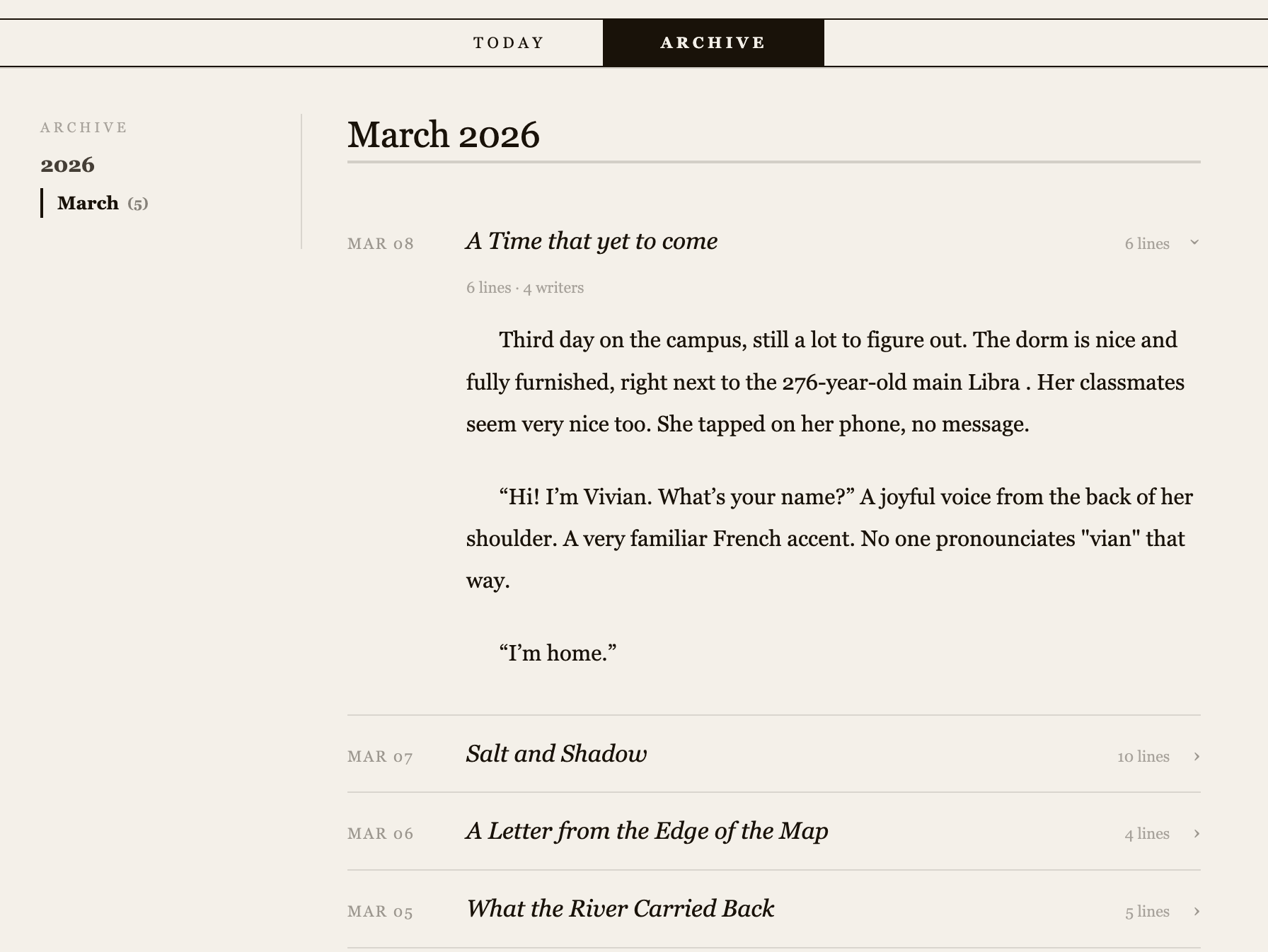
The story is sealed at midnight, and saved to permanent archive
The title for next day is generated by AI, inspired by what’s written in last story
*It’s deployed on Vercel, so you might have to whitelist it when you open the link.
A Shared Ownership
Don’t get me wrong. Credits are important, but we creatives have always been building on each others’ ideas since the world exists. Most creative platforms today are built for amplifying the “individual”, like everyone needs a profile, thousands of followers, and brand and so on. This creates a high-pressure and competitive environment where individuals often feel they must author a masterpiece or say nothing at all.
I wanted to design a "low-stakes" creative touchpoint, a place where contribution weighs more than perfection. On The Daily Tale, there are no usernames or social signals, every writer is displayed equally. All the focus is purely on writing together, and co-creating, nothing else.
No Contribution is Too Small. Trust the Gift
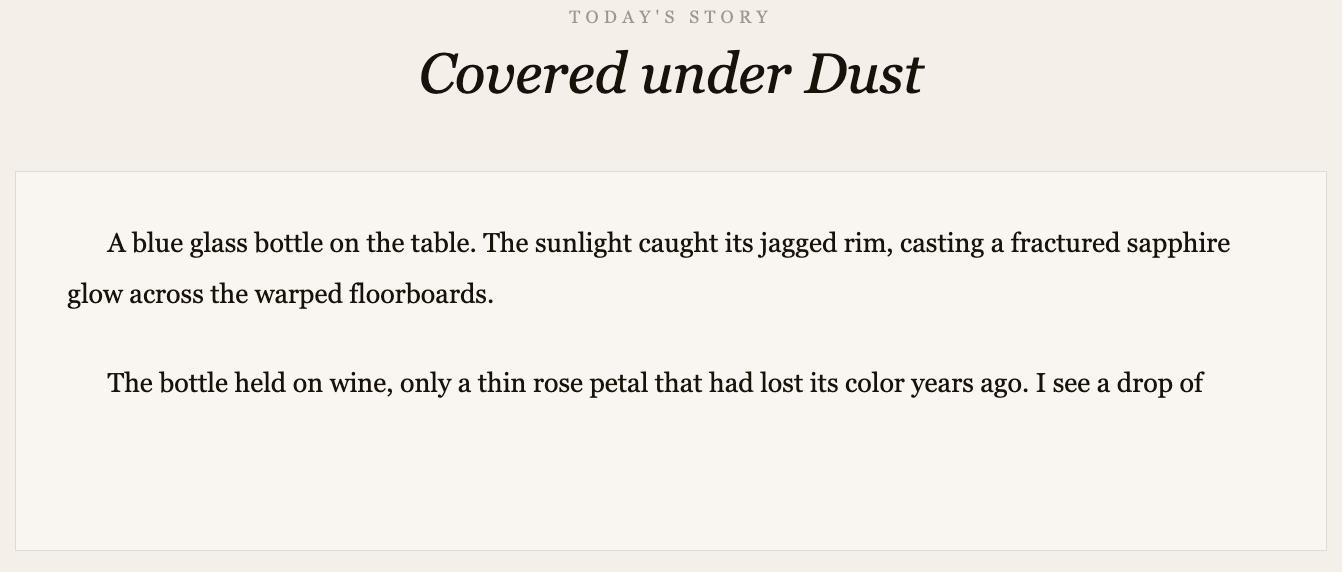
In improv, there are no mistakes, only gifts. I designed the interface to reflect this: a contribution can be a full sentence, a single phrase, a word, or even a symbol, all under 180 characters.
The platform is designed to let people express themselves in whatever way feels most comfortable in the moment. Whether you are adding a pivotal plot point or just a tiny texture to the atmosphere, the goal is to receive what came before you and offer your own small gift to the story.
By lowering the barrier of what "counts" as writing, I wanted to invite everyone to let go of the ego and the pressure to be "perfect." It is about trusting the collective creation and leaning into a connected group mind, knowing that the process itself will weave these disparate offerings into a meaningful whole.
Intentional Constraints
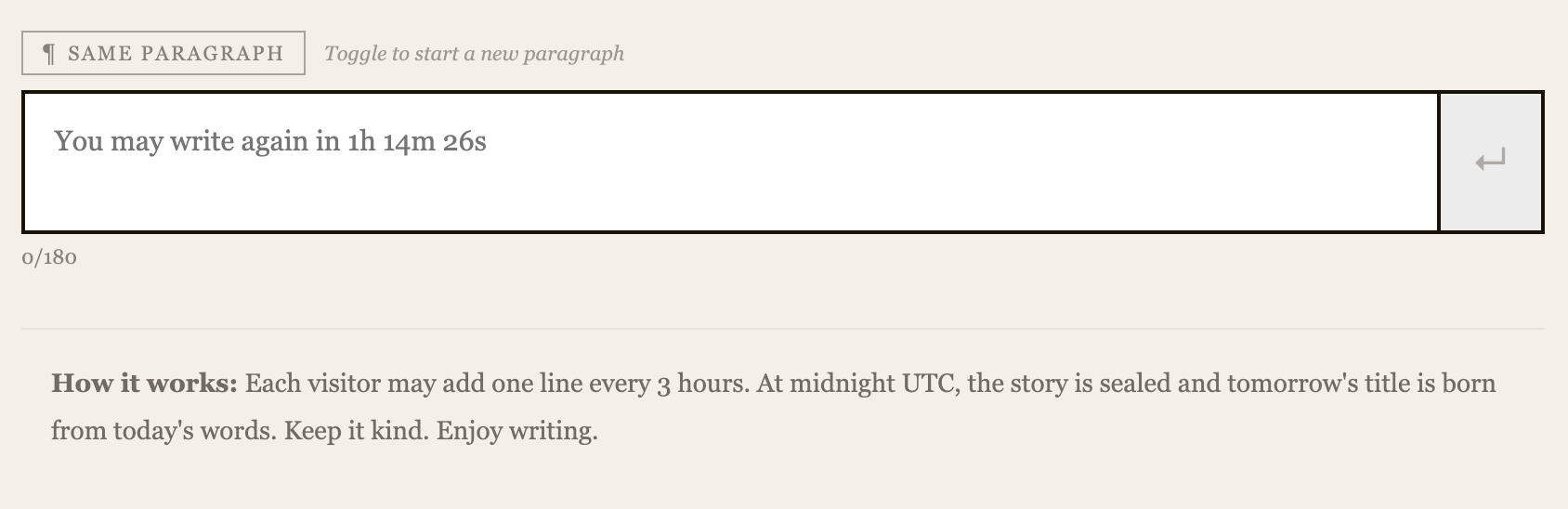
There are two features that most testers questioned about:
(a) Max 180 characters
(b) 3-hour cooldown timer
In a world of instant gratification, why force a user to wait?
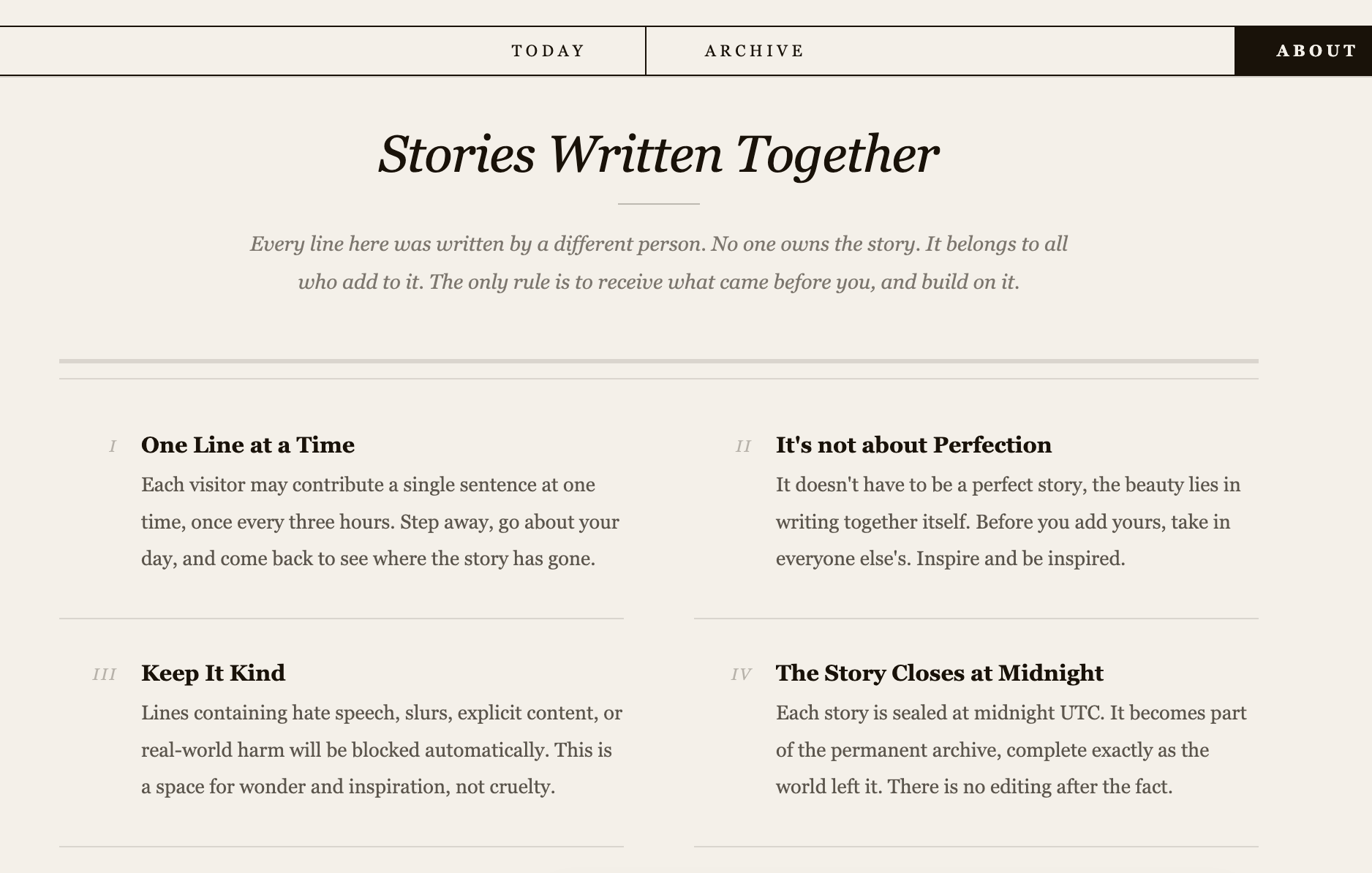
My answer is “It’s by design“. To be good at improvising, you have to know “give and take“. Simply take turns to take the space, then give the space to others. Limiting each visitor to a single line every three hours is because that the platform is not designed to be a "chat board" or “comment wall“, it’s a shared backyard. Once they have written something, step away, let the story breathe, and return later to see where the rest of the world has taken it.
No Profiles: Each ID is anonymous and stored only on their local device.
No Likes: The reward is the story itself, not a notification.
No Edits: Once a story is sealed at midnight UTC, it becomes part of the permanent archive, exactly as the world left it.
Designing for Kindness
To keep this shared space space, I integrated Claude, not as a replacement for human creativity, but as a guardian of it. The idea is to allow the story to grow organically and safely in realtime.
Every sentence submitted passes through a "Kindness Filter". The AI doesn't rewrite the story, it ensures the environment remains literary and safe from the vitriol that often plagues anonymous spaces. I also have a daily checker to make sure no harmful words slip past the AI guardian.
Technical Takeaways for Designers
This little experiment gave me the chance to run it as a software product project, which is new to me as a designer. Here are my three core technical and philosophical takeaways:
1. Measure Twice, Cut Once
Take enough time to think and plan deeply before moving a single pixel. Developing a comprehensive Product Requirements Document and a structured set of test cases in advance could have saved me from hours of going back and forth. When I know (almost) exactly how a feature should behave under stress, the design follows with clarity.
2. Respect the Workflow
If you are like me, a designer at heart, learning the basics of software project management would be very helpful. Simply handling version control in GitHub would have saved me the headache of "fixing my own mess" while debugging. Having a clean, dedicated change log of "the what and the why" is just as important as the code itself.
3. Stay Human, Design for Human
Working with AI requires a strong backbone, that’s our design intent. It is easy to let the model suggest generic paths for UX and copy, but designer should be the one to make the ultimate judgment call. Our users are human, we designers are designing for human interactions and connections. We have to be the one to steer the ship, don't let AI think for us.
A Living Archive
What emerges at the end of each day is always surprising. One day it’s a Gothic mystery about a map; the next, a whimsical tale of a grandmother’s kitchen. These stories belong to everyone and no one.
The Daily Tale isn't just a writing platform; it’s an invite to everyone. It’s a reminder that when we stop trying to "win" the internet and start trying to "build" with one another, the results are far more poetic than any algorithm could ever generate.
Click picture to start writing!